Tuesday, August 25, 2015

Jupiter Today | 26 August 2015 | Superior Conjunction!

Hello! Today is a special day in that it is the day of Superior Conjunction.  SC is when a planet is in alignment with the Sun with respect to another planet.  Mercury and Venus have both Inferior and Superior Conjunctions as seen from Earth, but all of the planets with orbits larger than Earth have only Superior Conjunctions.  SC is also the time and place where the two bodies end moving away from one another and begin moving toward one another.  This motion will continue until Opposition.

JUPITER TODAY is a daily blog about the dynamic Jupiter system for the purpose of monitoring activity.

We start with the overall view of activity with the Jupiter system, showing the orbits of the four Galilean moons:


This is a view of the Jupiter system looking down on it.  Following the blue line to the left is the line of sight to Earth, while following the gray line to the left is the line of sight to the Sun.  The orbits of the four Galilean moons are shown.  The large dots indicate the position of each moon at 0h, 6h, 12h, 18h, and 24h (0h the next day) UTC for this date.  From this point of view, the moons revolve around Jupiter in a counter-clockwise motion.  For more information about this graphic, see the post from 30 July 2015.

Jupiter continues to move towards Superior Conjunction on 26 August.  These images blow me away they are so incredibly beautiful.  Here's the current SOHO image showing the steady progress:


The graph below shows the positions of the four Galilean moons over the next 24 hours as seen from Earth.  The curved lines show the path of each moon through time.  The dark band in the center is Jupiter.  The x-axis is the distance, in arc seconds, from the center of Jupiter:


At 0h UTC, Io has just gone through its eastern elongation and is now in quad 2 moving west.  Europa starts the day in quad 3 moving west.  Ganymede spends all day in quad 1 heading east.  Callisto has settled into quad 2 moving west and will be there the next few days.

By 6h UTC, Io is now firmly in quad 2 heading west.  Europa is near western elongation and will be moving into quad 4 heading east.

At 12h UTC, Io has transited Jupiter and is now firmly in quad 3 moving west.  Europa has passed its western elongation and is now in quad 4 moving east.

At 18h UTC, Io is near its western elongation and will be moving into quad 4 heading east.

By 0h UTC tomorrow, Io is firmly in quad 4 moving east.  Europa is also in quad 4 heading east.  Ganymede continues in quad 1 moving east.  Callisto is out there nearly 2 million km from Jupiter orbiting in quad 2 heading west.

The position of Jupiter on Earth's celestial sphere today is RA 10h 20m 49.4s, DEC +11d 14m 21.3s.  The phase angle is 0.208 degrees, which is 0.107 degrees less than yesterday.  The angle between Jupiter and the Sun as seen from Earth is 1.109 degrees, which is 0.568 degress less than yesterday.  At the time of Superior Conjunction (about 22h UTC) the separation angle will be at a minimum at 0.873 degrees.  The distance between Jupiter and the Sun is 806,019,276 km, which is 36,484 km further apart than yesterday.  Jupiter and the Sun are moving away from one another at a velocity of 1,520.167 km/h, which is 1.75 km/h slower than yesterday.  The distance between Jupiter and Earth is 957,186,157 km, which is 46,548 km greater than yesterday.  Jupiter and Earth are moving away from one another at a velocity of 1,939.5 km/h, which is 1,288.083 km/h slower than yesterday.  The distance at SC is 957,201,696 km.

From 08:26 to 10:45 UTC, Io transits Jupiter.  Io's shadow also transits Jupiter at nearly the same time interval from 08:27 to 10:45 UTC.

Now the Glorious Orbital Ribbons for this Glorious Superior Conjunction:


Jupiter is so near Superior Conjunction (taking place at 22:00 UTC on 26 August 2015) that photography and other data collection isn't practical.  We'll have to wait about a months after SC to start viewing the Jupiter system again.

Spread the word about this daily blog!  This blog is subject to evolution.  What can I do to make this blog more interesting and more informative?

Subscribe at the right column of this blog and get these posts sent to you automatically!

Please send me your feedback, comments, and questions to jupitertoday AT gmail DOT com or the comments section of this blog.

With my gratitude, the data used to create the orbit plots and ribbons was supplied by the JPL Horizons website.  The graphics showing the location of the four moons as seen from Earth are via 'Jupiter Viewer 2.8'.  Jupiter-Satellite and Satellite mutual events data is supplied from IMCEE.

Until tomorrow, I bid you Peace.  

Monday, August 24, 2015

Jupiter Today | 25 August 2015 | Three Moon Symmetry

Hello!

JUPITER TODAY is a daily blog about the dynamic Jupiter system for the purpose of monitoring activity.

We start with the overall view of activity with the Jupiter system, showing the orbits of the four Galilean moons:


This is a view of the Jupiter system looking down on it.  Following the blue line to the left is the line of sight to Earth, while following the gray line to the left is the line of sight to the Sun.  The orbits of the four Galilean moons are shown.  The large dots indicate the position of each moon at 0h, 6h, 12h, 18h, and 24h (0h the next day) UTC for this date.  From this point of view, the moons revolve around Jupiter in a counter-clockwise motion.  For more information about this graphic, see the post from 30 July 2015.

Jupiter continues to move towards Superior Conjunction on 26 August.  These images blow me away they are so incredibly beautiful.  Here's the current SOHO image showing the steady progress:


I'm going to show you a different graphic for the moon location as a function of time, which is produced by the same site that produces the images.  I am so grateful for that site!  The graphic shows the motion of the four Galilean moons as seen from Earth.  The curved lines show the path of each moon through time.  The dark band in the center is Jupiter.  The x-axis is the distance, in arc seconds, from the center of Jupiter.

At 0h UTC, Io begins the day near western elongation and moving into quad 4 heading east.  Europa starts the day in quad 2 moving west.  Ganymede starts the day in quad 4 moving east and will be moving behind Jupiter today.  Callisto spends most of the day in quad 1 heading east.

By 6h UTC, Io is firmly in quad 4 moving east.

At 12h UTC, Io is moving behind Jupiter.  Europa is transiting Jupiter,  Ganymede is about to start moving behind Jupiter.

By 18h UTC, Io is firmly in quad 1 moving east.  Europa is now past transit and moving west in quad 3.  Ganymede has now moved behind Jupiter and is now moving east in quad 1.  Callisto is at eastern elongation and will spend the next few days in quad 2 heading west.

At 0h UTC tomorrow, Io is at eastern elongation.  Europa is firmly in quad 3 moving west.  Ganymede is now firmly in quad 1 moving east.  Callisto is now in quad 2 heading west.

Today, the position of Jupiter is RA 10h 19m 59.7s, DEC +11d 19m 00.8s.  The phase angle is 0.315 degrees, which is 0.125 degrees less than yesterday.  The angular separation between Jupiter and the Sun as seen from Earth is 1.677 degrees, which is 0.669 degrees less than yesterday.  The distance between the Sun and Jupiter is 805,982,792 km, which is 36,526 km greater than yesterday.  Jupiter is moving away from the Sun at a velocity of 1,521.917 km/h, which is 1.792 km/h faster than yesterday.  Jupiter is 957,139,609 km away from Earth, which is 77,462 km greater than yesterday.  We are moving away from Jupiter at a velocity of 3,227.583 km/h, which is 1,285.5 km/h slower than yesterday.

At 11:10 UTC, Io moves behind Jupiter.  From 12:14 to 15:06 UTC, Europa transits Jupiter.  From 12:17 to 15:08 UTC, Europa's shadow transits Jupiter.  At 13:28 UTC, Io reappears from behind Jupiter.  At 14:46, Ganymede moves behind Jupiter.  At 18:27 UTC, Ganymede reappears from behind Jupiter.

Orbital Ribbons for today.  Notice the symmetry between Io, Europa, and Ganymede:


Jupiter is so near Superior Conjunction (taking place at 22:00 UTC on 26 August 2015) that photography and other data collection isn't practical.  We'll have to wait about a months after SC to start viewing the Jupiter system again.

Spread the word about this daily blog!  This blog is subject to evolution.  What can I do to make this blog more interesting and more informative?

Subscribe at the right column of this blog and get these posts sent to you automatically!

Please send me your feedback, comments, and questions to jupitertoday AT gmail DOT com or the comments section of this blog.

With my gratitude, the data used to create the orbit plots and ribbons was supplied by the JPL Horizons website.  The graphics showing the location of the four moons as seen from Earth are via 'Jupiter Viewer 2.8'.  Jupiter-Satellite and Satellite mutual events data is supplied from IMCEE.

Until tomorrow, I bid you Peace.  

Sunday, August 23, 2015

Jupiter Today | 24 August 2015 | All Quads

Hello!

JUPITER TODAY is a daily blog about the dynamic Jupiter system for the purpose of monitoring activity.

We start with the overall view of activity with the Jupiter system, showing the orbits of the four Galilean moons:


This is a view of the Jupiter system looking down on it.  Following the blue line to the left is the line of sight to Earth, while following the gray line to the left is the line of sight to the Sun.  The orbits of the four Galilean moons are shown.  The large dots indicate the position of each moon at 0h, 6h, 12h, 18h, and 24h (0h the next day) UTC for this date.  From this point of view, the moons revolve around Jupiter in a counter-clockwise motion.  For more information about this graphic, see the post from 30 July 2015.

Jupiter continues to move towards Superior Conjunction on 26 August.  These images blow me away they are so incredibly beautiful.  Here's the current SOHO image showing the steady
progress:


I'm going to show you a different graphic for the moon location as a function of time, which is produced by the same site that produces the images.  I am so grateful for that site!  The graphic shows the motion of the four Galilean moons as seen from Earth.  The curved lines show the path of each moon through time.  The dark band in the center is Jupiter.  The x-axis is the distance, in arc seconds, from the center of Jupiter.


At 0h UTC, Io starts the day in quad 1 moving east.  Europa is also in quad 1 moving east.  Ganymede is just past western elongation and will be in quad 4 moving east all day.  Callisto spends another day in quad 1 heading east.

By 6h UTC, Io is past its eastern elongation and is now in quad 2 moving west.

At 12h UTC, Io is about to transit Jupiter.

At 18h UTC, Io has successfully tranisted Jupiter and is now firmly in quad 3 moving west.  Europa is just past its eastern elongation and is now in quad 2 moving west.

By 0h UTC tomorrow, Io is near its western elongation.  Europa is now firmly in quad 2 moving west.  Ganymede continues in quad 4 moving east.  Callisto will be in quad 1 one more day.

At 13:44 UTC, Io goes through it's apojove at a distance of 423,489.6 km.

At 0h UTC, the position of Jupiter is RA 10h 19m 09.9s, DEC +11d 23m 39.9s.  The phase angle is 0.440 degrees, which is 0.133 degrees less than yesterday.  The angular separation between Jupiter and the Sun is 2.346 degrees, which is 0.705 degrees less than yesterday.  The distance between Jupiter and the Sun is 805,946,266 km, which is 36,483 km further away than yesterday.  Jupiter is moving away from the Sun at a velocity of 1,520.125 km/h, which is 5.958 km/h slower than yesterday.  The distance between Jupiter and Earth is 957,062,147 km, which is 108,314 km greater than yesterday.  Jupiter and Earth are moving away from each other at a velocity of 4,513.083 km/h, which is 1,294.042 km/h slower than yesterday.  Feel those bumps????

From 13:56 to 16:14, Io transits Jupiter.  From 13:58 to 16:16 UTC, Io's shadow transits Jupiter.

The Glorious Orbital Ribbons:


Jupiter is so near Superior Conjunction (taking place at 22:00 UTC on 26 August 2015) that photography and other data collection isn't practical.  We'll have to wait about a months after SC to start viewing the Jupiter system again.

Spread the word about this daily blog!  This blog is subject to evolution.  What can I do to make this blog more interesting and more informative?

Subscribe at the right column of this blog and get these posts sent to you automatically!

Please send me your feedback, comments, and questions to jupitertoday AT gmail DOT com or the comments section of this blog.

With my gratitude, the data used to create the orbit plots and ribbons was supplied by the JPL Horizons website.  The graphics showing the location of the four moons as seen from Earth are via 'Jupiter Viewer 2.8'.  Jupiter-Satellite and Satellite mutual events data is supplied from IMCEE.

Until tomorrow, I bid you Peace.  

Saturday, August 22, 2015

Jupiter Today | 23 August 2015 | Io and Europa

Hello!

JUPITER TODAY is a daily blog about the dynamic Jupiter system for the purpose of monitoring activity.

We start with the overall view of activity with the Jupiter system, showing the orbits of the four Galilean moons:


This is a view of the Jupiter system looking down on it.  Following the blue line to the left is the line of sight to Earth, while following the gray line to the left is the line of sight to the Sun.  The orbits of the four Galilean moons are shown.  The large dots indicate the position of each moon at 0h, 6h, 12h, 18h, and 24h (0h the next day) UTC for this date.  From this point of view, the moons revolve around Jupiter in a counter-clockwise motion.  For more information about this graphic, see the post from 30 July 2015.

Jupiter continues to move towards Superior Conjunction on 26 August.  These images blow me away they are so incredibly beautiful.  Here's the current SOHO image showing the steady progress:


I'm going to show you a different graphic for the moon location as a function of time, which is produced by the same site that produces the images.  I am so grateful for that site!  The graphic shows the motion of the four Galilean moons as seen from Earth.  The curved lines show the path of each moon through time.  The dark band in the center is Jupiter.  The x-axis is the distance, in arc seconds, from the center of Jupiter.

At 0h UTC, Io begins the day firmly in quad 3 moving west.  Europa has just passed its western elongation and is in quad 4 moving east most of the day.  Ganymede spends most of the day heading west in quad 3.  Callisto spends yet another day in quad 1 moving east.

By 6h UTC, Io is very near western elongation and will be moving into quad 4 heading east.

At 12h UTC, Io is firmly in quad 4 moving east.

At 18h UTC, Io and Europa are moving behind Jupiter.  Ganymede is near western elongation and will be moving into quad 4 heading west.

By 0h UTC tomorrow, Io and Europa are both in quad 1 heading east.  Ganymede is now past western elongation and is in quad 4 heading east.  Callisto continues in quad 1 moving east.

At 00:29 UTC, Callisto goes through its apojove at a distance of 1,896,276.0 km.  At 16:36 UTC, Europa goes through its apojove at a distance of 677,661.4 km.  At 16:45, Io goes through its perijove at a distance of 420,044.7 km.

At 0h UTC, the position of Jupiter is RA 10h 18m 20.2s, DEC +11d 28m 18.6s.  The phase angle is 0.573 degrees, which is 0.135 degrees less than yesterday.  The angle between Jupiter and the Sun as seen from Earth is 3.051 degrees, which is 0.721 degrees less than yesterday.  The distance between Jupiter and the Sun is 805,909,783 km, which is 36,629 km greater than yesterday.  Jupiter is moving away from the sun at a velocity of 1,526.083 km/h, which is 2.917 km/h slower than yesterday.  Jupiter is 956,953,833 km from Earth, which is 139,371 km further away than yesterday.  The two planets appear to be moving away from each other at a speed of 5,807.125 km/h, which is 1,291,083 km/h slower than yesterday.  Their relative velocity will be at a minimum at the moment of Superior Conjunction.

At 16:40 UTC, Io moves behind Jupiter.  At 17:36, Europa moves behind Jupiter.  Io reappears from behind Jupiter at 19:00 UTC, followed by Europa at 20:37 UTC.

No satellite mutual events to report.

And now, the Glorious and Beautiful Orbital Ribbons:


And just for fun and because it's so incredibly beautiful, here's a pretty one that marks the relative orbits of the Uranian moons Miranda and Ariel:


Jupiter is so near Superior Conjunction (taking place at 22:00 UTC on 26 August 2015) that photography and other data collection isn't practical.  We'll have to wait about a months after SC to start viewing the Jupiter system again.

Spread the word about this daily blog!  This blog is subject to evolution.  What can I do to make this blog more interesting and more informative?

Subscribe at the right column of this blog and get these posts sent to you automatically!

Please send me your feedback, comments, and questions to jupitertoday AT gmail DOT com or the comments section of this blog.

With my gratitude, the data used to create the orbit plots and ribbons was supplied by the JPL Horizons website.  The graphics showing the location of the four moons as seen from Earth are via 'Jupiter Viewer 2.8'.  Jupiter-Satellite and Satellite mutual events data is supplied from IMCEE.

Until tomorrow, I bid you Peace. 

Friday, August 21, 2015

Jupiter Today | 22 August 2015 | Four Moon Alignment

Hello!  Many apologies for the couple of days I've missed this post.  Technical difficulties.

JUPITER TODAY is a daily blog about the dynamic Jupiter system for the purpose of monitoring activity.

We start with the overall view of activity with the Jupiter system, showing the orbits of the four Galilean moons:


This is a view of the Jupiter system looking down on it.  Following the blue line to the left is the line of sight to Earth, while following the gray line to the left is the line of sight to the Sun.  The orbits of the four Galilean moons are shown.  The large dots indicate the position of each moon at 0h, 6h, 12h, 18h, and 24h (0h the next day) UTC for this date.  From this point of view, the moons revolve around Jupiter in a counter-clockwise motion.  For more information about this graphic, see the post from 30 July 2015.

Jupiter continues to move towards Superior Conjunction on 26 August.  Here's the current SOHO image showing the steady progress:


At 0h UTC, Io begins the day pretty much directly behind Jupiter moving east in quad 1.  Europa and Ganymede start the day transiting Jupiter together and moving west in quad 3.  Callisto will spend all day in quad 1 heading east.

By 6h UTC, Io is firmly in quad 1 moving east.  Europa and Ganymede are now firmly in quad 3 heading west.

At 12h UTC, Io has gone past its eastern elongation and is now in quad 2 moving west.

By 18h UTC, Io is about to begin transiting Jupiter, while Europa will soon be at its western elongation and moving into quad 4.

At 0h UTC tomorrow, Io has transited Jupiter and is now in quad 3 moving west.  Europa has just passed its western elongation and is now in quad 4 moving east.  Ganymede continues in quad 3.  Callisto will be in quad 1 for the next few days.

Io goes through an apojove at 19:27 UTC at a distance of 423,496.2 km.

At 0h UTC, Jupiter's position on Earth's celestial sphere is RA 10h 17m 30.4s, DEC +11d 32m 56.7s.  The phase angle today is 0.708 degrees, which is 0.137 degrees less than yesterday.  The angular separation between Jupiter and the Sun is 3.772 degrees, which is 0.729 degrees less than yesterday.  The distance between Jupiter and the Sun is 805,873,154 km, which is 36,696 km further away than yesterday.  Jupiter is moving away from the Sun at a velocity of 1,529.0 km/h, which is 5.667 km/h slower than yesterday.  Jupiter is 956,814,462 km away from Earth, which is 170,357 km further away than yesterday.  Jupiter and Earth are moving away from one another (mainly due to Earth's motion around the Sun) at a velocity of 7,098.2 km/h, which is 1,294.209 km/h slower than yesterday.  We continue to decelerate as we move towards Superior Conjunction on the 26th of the August.

From 00:30 to 04:08 UTC, Ganymede transits Jupiter.  From 00:51 to 04:26, the shadow of Ganymede transits Jupiter.  At 00:31 Io reappears from Jupiter's shadow.  Europa will end its transit of Jupiter at 01:42 UTC, and Europa's shadow will end its transit at 01:51 UTC.  Io transits Jupiter from 19:25 to 21:44 UTC, and Io's shadow follows from 19:30 to 21:48 UTC.

For the final reported satellite mutual event of this very active 2015 season, Ganymede will occult Europa from 20:45 to 20:57 UTC.  This 12.2 minute event has an impact parameter of 0.731 arc seconds -- a shallow occultation.

The Glorious Orbital Ribbons:


Jupiter is so near Superior Conjunction (taking place at 22:00 UTC on 26 August 2015) that photography and other data collection isn't practical.  We'll have to wait about a months after SC to start viewing the Jupiter system again.

Spread the word about this daily blog!  This blog is subject to evolution.  What can I do to make this blog more interesting and more informative?

Subscribe at the right column of this blog and get these posts sent to you automatically!

Please send me your feedback, comments, and questions to jupitertoday AT gmail DOT com or the comments section of this blog.

With my gratitude, the data used to create the orbit plots and ribbons was supplied by the JPL Horizons website.  The graphics showing the location of the four moons as seen from Earth are via 'Jupiter Viewer 2.8'.  Jupiter-Satellite and Satellite mutual events data is supplied from IMCEE.

Until tomorrow, I bid you Peace.  

Tuesday, August 18, 2015

Jupiter Today | 19 August 2015 | Ganymede Alone

Hello!

JUPITER TODAY is a daily blog about the dynamic Jupiter system for the purpose of monitoring activity.

We start with the overall view of activity with the Jupiter system, showing the orbits of the four Galilean moons:


This is a view of the Jupiter system looking down on it.  Following the blue line to the left is the line of sight to Earth, while following the gray line to the left is the line of sight to the Sun.  The orbits of the four Galilean moons are shown.  The large dots indicate the position of each moon at 0h, 6h, 12h, 18h, and 24h (0h the next day) UTC for this date.  From this point of view, the moons revolve around Jupiter in a counter-clockwise motion.  For more information about this graphic, see the post from 30 July 2015.


Jupiter continues to move towards Superior Conjunction on 26 August.  Here's the current SOHO image showing the steady progress:

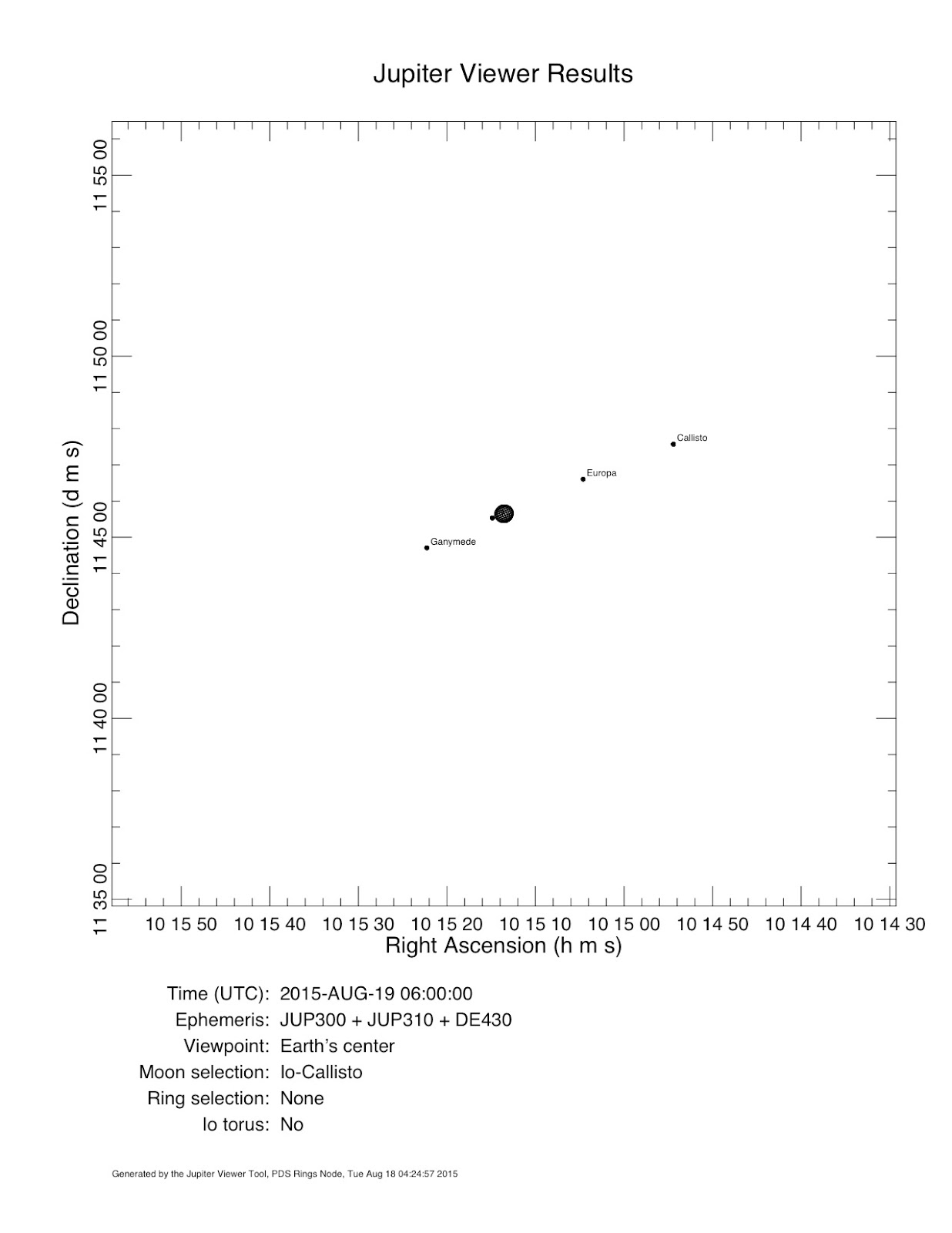
At 0h UTC, Io begins the day in quad 2 moving west.  Europa is in quad 3 also moving west.  Ganymede spends all day moving east in quad 1.  Callisto spends all day in quad 4 moving east towards Jupiter.

By 6h UTC, Io is about to begin its transit of Jupiter.  Europa is close to its western elongation and will be moving into quad 4 heading east.

At 12h UTC, Io has successfully transited and is now firmly in quad 3 heading west.  Europa is now firmly in quad 4 moving east the rest of the day.

By 18h UTC, Io is at western elongation and moving into quad 4.

At 0h UTC tomorrow, Io, Europa, and Callisto are all to the west of Jupiter in quad 4 moving east.  Ganymede is alone to the east of Jupiter in quad 1.

At 06:51 UTC, Io goes through an apojove (the furthest it will be from Jupiter in this orbit) at a distance of 423,487.7 km.

At 0h UTC, the position of Jupiter is RA 10h 15m 01.1s, DEC +11d 46m 48.1s.  The phase angle today is 1.12 degrees, which is 0.138 degrees less than yesterday.  The angular separation between Jupiter and the Sun is 5.97 degrees, which is 0.738 degrees less than yesterday.  The distance between Jupiter and the Sun is 805,762,860 km, which is 36,814 km further away than yesterday.  Jupiter and the Sun are moving apart at a velocity of 1,533.917 km/h, which is 0.958 km/h slower than yesterday.  Wobble, wobble, wobble.  The distance between Jupiter and the Earth is 956,210,424 km, which is 263,205 km further apart than yesterday.  Jupiter and Earth are moving away from one another at a velocity of 10,966.875 km/h, which is 1,286.917 km/h slower than yesterday.  So while we're moving away from Jupiter, we are decelerating at an ever larger amount.  It's very similar to going over a very large speed bump.

From 06:25 to 08:43, Io transits Jupiter.  From 06:32 to 08:50, the shadow of Io transits Jupiter.

From 21:22 to 22:00 UTC, Io occults Europa.  This is a 38.3 minute event with an impact parameter of 0.305 arc seconds.  A graze.  From 21:54 to 23:21 UTC, Io eclipses Europa.  This long 87.1 minute event has an impact parameter of 0.093 arc seconds, which is a pretty nice eclipse.  From 23:46 to 01:21 UTC tomorrow, Io eclipses Europa once again.  This is also very long ad deep at 94.7 minutes with an impact parameter of 0.081 arc seconds.  I can't figure out the motions such that we'd see two eclipses back to back.  I'll try to figure that out and report on in over the next couple days.

And now the Glorious Orbital Ribbons:


Jupiter is so near Superior Conjunction (taking place at 22:00 UTC on 26 August 2015) that photography and other data collection isn't practical.  We'll have to wait about a months after SC to start viewing the Jupiter system again.

Spread the word about this daily blog!  This blog is subject to evolution.  What can I do to make this blog more interesting and more informative?

Subscribe at the right column of this blog and get these posts sent to you automatically!

Please send me your feedback, comments, and questions to jupitertoday AT gmail DOT com or the comments section of this blog.

With my gratitude, the data used to create the orbit plots and ribbons was supplied by the JPL Horizons website.  The graphics showing the location of the four moons as seen from Earth are via 'Jupiter Viewer 2.8'.  Jupiter-Satellite and Satellite mutual events data is supplied from IMCEE.

Until tomorrow, I bid you Peace. 

Monday, August 17, 2015

Jupiter Today | 18 August 2015 | Ganymede Hides

Hello!

JUPITER TODAY is a daily blog about the dynamic Jupiter system for the purpose of monitoring activity.

We start with the overall view of activity with the Jupiter system, showing the orbits of the four Galilean moons:


This is a view of the Jupiter system looking down on it.  Following the blue line to the left is the line of sight to Earth, while following the gray line to the left is the line of sight to the Sun.  The orbits of the four Galilean moons are shown.  The large dots indicate the position of each moon at 0h, 6h, 12h, 18h, and 24h (0h the next day) UTC for this date.  From this point of view, the moons revolve around Jupiter in a counter-clockwise motion.  For more information about this graphic, see the post from 30 July 2015.

At 0h UTC, Io begins the day at western elongation and will be in quad 4 moving east.  Europa is in quad 2 heading west.  Ganymede starts the day in quad 4 moving east towards Jupiter.  Callisto spends all day in quad 4 heading east.

By 6h UTC, Io is firmly in quad 4 moving east.  Europa is still in quad 2, but will be transiting Jupiter soon.

At 12h UTC, Io has moved behind Jupiter and Europa has transited Jupiter.  Ganymede is now moving behind Jupiter as well and is moving into quad 1 heading east.

By 18h UTC, Io is coming up on its eastern elongation.  Europa is now firmly in quad 3 heading west the rest of the day.  Ganymede has successfully moved behind Jupiter.

At 0h UTC tomorrow, Io has passed its eastern elongation and is now in quad 2 moving west.  Europa is firmly in quad 3 moving west.  Ganymede is moving east in quad 1.  Callisto continues in quad 4 moving east.

At 06:04 UTC, Ganymede goes through an apojove at a distance of 1,071,880.7 km.  At 09:49 UTC, Io goes through a perijove at a distance of 420,036.7 km.  At 09:53 UTC, Europa goes through its perijove at a distance of 664,495.5 km.

At 0h UTC, the position of Jupiter on Earth's celestial sphere is RA 10h 14m 11.3s, DEC +11d 51m 24.0s.  The phase angle today is 1.258 degrees, which is 0.138 degrees less than yesterday.  The angular separation between Jupiter and the Sun as seen from Earth is 6.708 degrees, which is 0.739 degrees less than yesterday.  The distance between Jupiter and the Sun is 805,726,046 km, which is 36,837 km greater than yesterday.  Jupiter appears to be moving away from the Sun at a velocity of 1,534.875 km/h, which is 0.792 km/h faster than yesterday.  The distance between Jupiter and Earth is 955,947,219 km, which is 294,091 km further apart than yesterday.  Jupiter and Earth appear to be moving apart at a velocity of 12,253.792 km/h, which is 1,283.625 km/h slower than yesterday.

At 09:09 UTC, Io moves behind Jupiter.  From 09:26 to 12:18, Europa transits Jupiter.  From 09:43 to 12:34, the shadow of Europa transits Jupiter.  At 10:18 UTC, Ganymede moves behind Jupiter.  At 11:34 UTC, Io reappears from Jupiter's shadow.  At 14:29 UTC, Ganymede reappears from Jupiter's shadow.

There are no satellite mutual events today.

Now for the glorious Orbital Ribbons:


I also continue to enjoy the spectacle of Superior Conjunction, visible now with the SOHO spacecraft:

Spread the word about this daily blog!  This blog is subject to evolution.  What can I do to make this blog more interesting and more informative?

Subscribe at the right column of this blog and get these posts sent to you automatically!

Please send me your feedback, comments, and questions to jupitertoday AT gmail DOT com or the comments section of this blog.

With my gratitude, the data used to create the orbit plots and ribbons was supplied by the JPL Horizons website.  The graphics showing the location of the four moons as seen from Earth are via 'Jupiter Viewer 2.8'.  Jupiter-Satellite and Satellite mutual events data is supplied from IMCEE.

Until tomorrow, I bid you Peace.